Articles
The Double-Sided Peace: How Sanaag Youth Mediated the Laashimo Valley Conflict
By Ishak Abdullahi Mohamed
Interclan violence broke out in Laashimo Valley in Sanaag Region, Puntland, Somalia, on May 6 and 7, 2025. Over 9,000 residents, 85% of them were women and children, were driven from their homes, and 31 individuals were murdered and 30 injured. What transpired is a tale that never appears in policy studies or donor briefings, but it contains lessons that all Horn of Africa peacebuilding organizations should be aware of.
The Roots of the Crisis
The Laashimo Valley dispute did not appear out of nothing. It was the most recent and violent phase of a protracted conflict between two Warsangali sub-clans, Garaad Cabdalle’s Bahogayslabe on one side and Nuux Yuusuf’s Muxummed on the other, over access to a water point and grazing land. The conflict has been going on for years under worsening drought conditions. Because both groups are sprung from the same larger Warsangali ancestry, this tragedy is very traumatic. These weren’t strangers separated by far-off grievances. Their shared genealogy linked them together as cousins, but the desperation caused by shortages and unresolved cycles of retaliation now tore them apart.
The extent of the relocation was astounding. Nine thousand people, or around 1,500 households, fled to nearby settlements in Carmala, Shimbirale, Qodax, Muug-libaax, Degelo, Naylo Gad, Rigooyin, Dhufeeco, and Qabdhac. Action Youth Initiative Development (AYID) and Puntland Minority Women Development Organization (PMWDO) conducted field assessments to document the experiences of those who fled: families who had lost their homes, livestock, and livelihoods in a matter of hours; children exhibiting signs of severe psychological distress, withdrawal, and fear; and women and girls exposed to gender-based violence in overcrowded, unsafe shelters. Some old and disabled people who were unable to escape were just abandoned. The assessors pointed out that their future was still up in the air.
There were no humanitarian organizations at the places of relocation. Poor road conditions, instability, and years of unresolved antagonism have long limited access to Laashimo Valley. On May 9, Puntland government troops finally moved in to create a military base and ease tensions. However, no official reaction reached the impacted community during the crucial window, the hours and days immediately after the violence, when thousands of civilians were without food, water, shelter, or safety.
An Idea Born from Within
There were no humanitarian organizations at the places of relocation. Poor road conditions, instability, and years of unresolved antagonism have long limited access to Laashimo Valley. On May 9, Puntland government troops finally moved in to create a military base and ease tensions. However, no official reaction reached the impacted community during the crucial window the hours and days immediately after the violence, when thousands of civilians were without food, water, shelter, or safety.
The seventeen young people banded together. They used their own funds to support the effort. Transportation from the Puntland Government, the Puntland Development Research Center (PDRC), and the Puntland Non State Actors Association (PUNSAA) was the only outside logistical assistance they got. The organization itself provided everything else, including the strategy, the dedication, and the bravery to enter a battle area. That origin is more than just a side note. It served as the cornerstone for the intervention’s overall legitimacy.
Into the Risk Zone
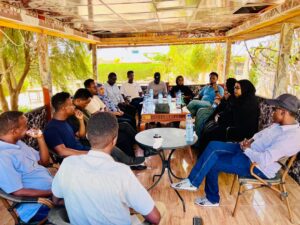
Before arriving in the four villages that made up the active risk zone Carmale, Shimbiraale, Dawaco, and Daarasalaam, the seventeen young people traveled via two regions and three cities. These locations were unstable. There were still armed organizations. There was still tension. There was still no official resolution to the violence that had claimed thirty-one lives a few days prior. Nevertheless, the young people entered.
They provided medicine and packages from the Ministry of Women to displaced families in the danger zone who had not received any outside assistance. On behalf of the impacted communities, they actively lobbied the Ministries of Health and Interior, making sure that civilian needs were given top priority. Surprisingly, they followed officials from five government agencies, two state ministries, two deputy ministries, and two full ministries into areas that official channels had found difficult to reach. The players who made it possible for the government to reach its own population in need were a self-organized group of young people acting without an official mandate. Every ministry and donor office working on Somalia should take this fact seriously. .
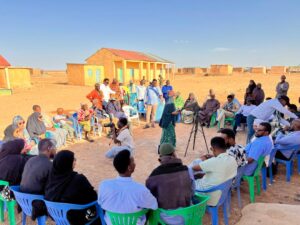
In addition to their urgent humanitarian efforts, the youth created two community peace forums, which were planned venues for mediated discourse between local leadership, community members, and representatives of both conflict groups. One of Sanaag’s top traditional elders, Sultan Said, was directly consulted. His involvement offered the element of customary authority necessary for any long-term peace process in the Somali setting. Additionally, they continued working in the four risk-zone communities after finishing their job there. In order to stop the violence from spreading and to strengthen early warning systems in communities that faced comparable dangers, they expanded their outreach to Haylan, a nearby area. They made this final decision on their own. It appeared in no project plan. It reflected something more important: an understanding that peace, like conflict, travels.
Why Both Sides Trusted Them
The question at the center of this case is one that every peacebuilding practitioner should sit with: why did both communities accept these youth when they had not accepted anyone else? The answer is not complicated, but its implications are profound.
These seventeen youths were from Sanaag. They were from Warsangali. They were concurrently attached to both sides of the conflict split by their personal history, social connections, and familial ties. They were not seen as representatives of either community. They were acknowledged as belonging to both communities. When two branches of the same clan tree clashed, young people who truly belonged to both branches had access that no outsider, no matter how well-funded or well-meaning, could match.
This is what I refer to as the “double-sided peace,” a type of mediation that is only feasible when the mediator is trusted by both sides simultaneously because they truly belong to both. In the traditional sense, it is not neutral. Being neutral means avoiding the dispute. These young people represented something different: they were deeply ingrained in both groups, which gave them a legitimacy that institutional neutrality will never match.
A second element is worth mentioning. This effort carried none of the organizational pressures, donor reporting requirements, or exit timeframes that influence the conduct of official peacebuilding players since it started from within the group—from a single member’s idea, supported by collective conviction. The young people had no log-frame to finish, no exit strategy to design, and no backer to satisfy. Only their communities and the peace they were attempting to establish held them accountable. No external system can create that accountability since it is of a different and deeper kind.
Then there was the danger. It was not symbolic to enter the area of actual warfare. It was a tangible indication that these young people prioritized peace over their personal safety, which was apparent to both communities. That presentation was crucial in conflict situations because credibility is gained via deeds rather than titles.
Where Things Stand
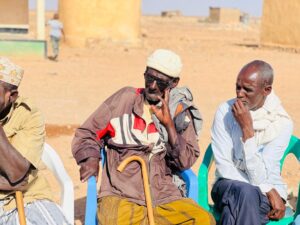
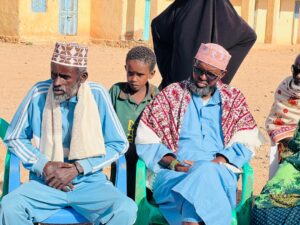
The two Warsangali sub-clans are actively conversing as of this writing. The narrative doesn’t end there. The disagreement about the water point has not been settled. The issue of land access is still unresolved. Despite the importance of two peace forums and a meeting with an elder, the unsolved problems that existed before May 2025 do not go away. The basis has shifted; two communities that were firing at each other are now conversing. The framework for a longer-lasting peace process has been established. The foundation for the construction was constructed by the young people of Sanaag, not the actual building.
What Institutions Must Reckon With
At Hiil Institute, our work on governance and peacebuilding in Puntland is grounded in a substantial body of policy literature on locally-led development, community resilience, and youth inclusion. Yet the Laashimo case reveals a persistent gap between how these concepts are written about and how resources and institutional frameworks are actually organized on the ground.
The whole expedition of these seventeen young people was self-funded. They could have responded more quickly and reached a wider audience if basic resources like dependable communications, medical supplies, and transportation had been pre-positioned with local youth networks in Sanaag. In order to enable locally embedded actors to respond in the crucial initial hours of a crisis, rather than the initial weeks, when formal response pipelines have finally been activated, Puntland institutions and international partners working on conflict prevention must create adaptable, quick-disbursement mechanisms.
The issue of acknowledgment goes beyond resources. There was no cluster report, no situation update, and no humanitarian coordination mechanism for this endeavor. The system that says it is bringing about peace in their area does not see the seventeen young people of Sanaag. This invisibility is structural rather than coincidental. Government response plans, donor reporting frameworks, and humanitarian information systems are all built around institutional players. The contributions of grassroots, unregistered, self-organized groups are neither captured or acknowledged by their architecture. We will continue to undervalue, undercount, and underfund the players who are frequently performing the most important job until that infrastructure is constructed.
Lastly, there is the duty of documentation. Because locally led peacebuilding occurs outside of the mechanisms that generate reports and assessments, it is consistently underreported. The Hiil Institute operates in part to bridge that knowledge gap, ensuring that events in Laashimo Valley are included in the body of research that influences programming and policy throughout Puntland and Somalia rather than only being known to the local population.
“Nabad waa nolol.” Peace is life. In Laashimo Valley, seventeen young Warsangali proved exactly what that means not in a policy document, but on the ground, at personal risk, without being asked.
We must cease viewing local youth as beneficiaries and begin acknowledging them as the practitioners they already are if we are serious about achieving peace in Puntland and Somalia. The seventeen young people of Sanaag didn’t wait for a mandate, a budget, or a program. They stepped toward a town that was ripping itself apart because they were trusted by both sides, accountable to both sides, and committed to establishing a lasting peace.
The two-sided peace is that. It is worthy of much more than our appreciation. It is worthy of our institutional backing.
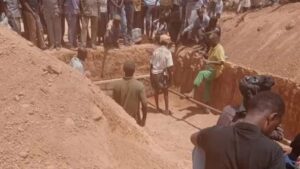
More than 30 lives were lost in the Laashimo Valley conflict. The community comes together in mourning.
Ishak Abdullahi Mohamed – Director of Programs, Hiil Institute for Governance and Development (HIGAD), Garowe, Puntland
References
Action Youth Initiative Development (AYID) & Puntland Minority Women Development Organisation (PMWDO). Sanaag Conflict and Displacement Crisis — Flash Report, Laashimo Valley. Field assessment, May 2025. Unpublished humanitarian field report.
Hiil Institute for Governance and Development (HIGAD). Direct engagement and interviews with the Sanaag youth peacebuilding initiative. Garowe, Puntland, May 2025.
Note: Several sources cited above are unpublished field reports, internal records, and direct engagements conducted by Hiil Institute (HIGAD) and partner organizations. They are cited here for transparency and may be made available to researchers and partners upon request.
#TheDoubleSidedPeace #PeaceBuilding #Somalia #Puntland #Sanaag #Warsangali #LaashimoValley #YouthLeadership #HiilInstitute #LocalPeace #HornOfAfrica